Every operational error in logistics leaves a clear footprint on a company's financial statements. As profit margins in the freight forwarding industry continue to shrink under competitive pressure, "hidden costs" stemming from delayed document processing, manual data errors, or low fleet utilization are silently eroding the cash flow of B2B enterprises. The difference between a sustainably growing logistics company and an entity struggling to maintain market share does not lie in the scale of physical assets, but in the capability to master data and automate processes.
This article will not repeat macro-level technology concepts. Instead, we analyze a core execution roadmap: shifting from a management mindset based on manual experience to an automated operational system – a solution that directly optimizes cost structures and enhances corporate competitiveness.
1. Current state of the Logistics industry: The cost of a manual mindset
Many logistics enterprises today still operate based on experience and isolated tools. The consequences of this model extend beyond schedule delays to tangible financial losses.

1.1. Bottlenecks in document management processes
The manual processing of core documents such as Master Bill of Lading (MBL), House Bill of Lading (HBL), invoices, and customs declarations carries a high probability of data discrepancy. When information among departments (Sales, Documentation, Accounting) is not synchronized in real-time, enterprises must consume a massive amount of resources simply to review and rectify errors.
1.2. Lack of transparency and control
Without a centralized management system, it is difficult for enterprises to accurately locate order status, truck routes, or control costs incurred during each leg (first-mile to last-mile). This lack of transparency directly reduces the satisfaction of B2B customers – a group that consistently demands high accuracy and service level agreement (SLA) commitments.
1.3. Wasted resources and opportunity costs
When personnel spend most of their time on repetitive tasks such as data entry, manual reconciliation, and coordination calls, the enterprise loses the capacity to focus on higher value-added activities, such as analyzing market data, optimizing routes, or managing strategic customer relationships.
2. A 4-step roadmap for comprehensive digital transformation in logistics
Digital transformation is not a change that happens overnight, but a strategic, incremental journey. To optimize investment costs and mitigate operational risks, logistics enterprises need to follow a structured roadmap consisting of 4 core stages:
[Stage 1: Digitization] ➔ [Stage 2: Process Digitalization] ➔ [Stage 3: Integration & Automation] ➔ [Stage 4: Intelligent Optimization]
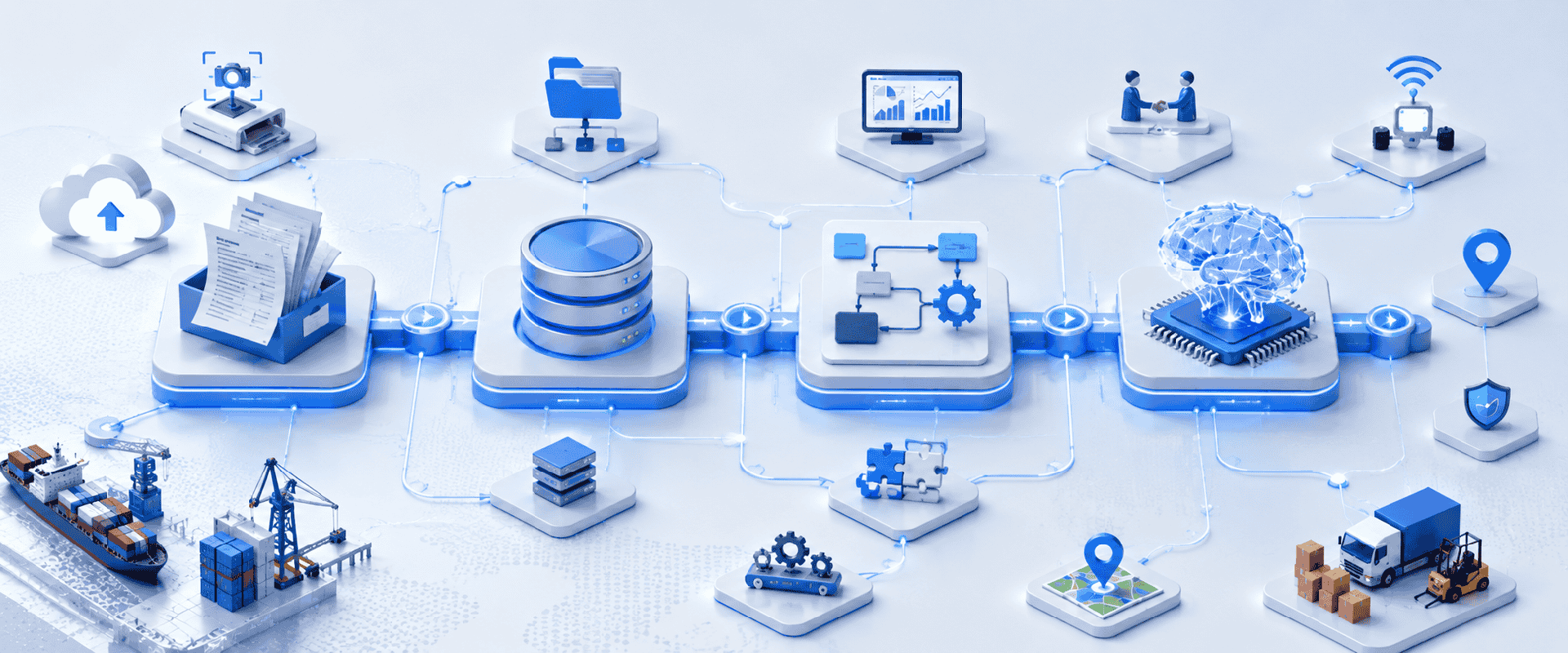
Stage 1: Data Digitization
The initial step of the roadmap is to convert all information from physical formats (paper, logbooks) into a digital format.
- Applying AI OCR (Optical Character Recognition): Automatically extract data from invoices, customs documents, and HBL/MBL to minimize manual data entry time.
- Building a centralized database: Ensure all information regarding customers, partners, freight rates, and shipping routes is stored consistently on a single platform, eliminating data silos.
Stage 2: Process digitalization
Once a digital data foundation is established, enterprises proceed to standardize and migrate operational processes onto software systems.
- Supply chain and transportation management: Implement a Transportation Management System (TMS) or specialized logistics management software to control operations from order receipt, quotation, and vehicle dispatching to delivery tracking.
- Financial and accounting management: Synchronize revenue and cost recognition processes in detail by job, automating debt calculations and reconciliation with shipping lines and agents.
Stage 3: System Integration and connected automation
At this stage, isolated software solutions are connected to form a unified ecosystem.
- Horizontal and vertical integration: Connect logistics software with Accounting systems, customer management CRM, and third-party portals (shipping lines, customs authorities, seapports).
- Workflow automation: When a shipment is completed, the system automatically sends notifications to customers, updates inventory status, and transfers reconciliation data to the accounting department without manual human intervention.
Stage 4: Intelligent optimization driven by data
The highest stage of digital transformation involves leveraging accumulated data for forecasting and strategic decision-making.
- Big data analytics: Evaluate the performance of each route, fleet utilization efficiency, and the profit margins of different customer segments.
- Forecasting and decision-making: Apply algorithms to optimize container stuffing and plan intelligent routes to save fuel and reduce lead time.
3. Key technologies shaping the future of logistics
To realize the aforementioned roadmap, logistics enterprises need to focus on investing in the following foundational technological solutions:

3.1. Cloud computing
The cloud platform allows management and field personnel to access data anytime, anywhere via mobile devices. This ensures supply chain continuity, especially in situations where unexpected field incidents require urgent handling.
3.2. Enterprise resource planning (ERP specialized for logistics)
An in-depth management system tailored for the transportation and freight forwarding industry helps synchronize all business operations: from Customer Relationship Management (CRM), Fleet Management System (FMS), and Warehouse Management System (WMS) to financial accounting in compliance with current standards.
3.3. IoT and real-time tracking
IoT sensor devices attached to transport vehicles help enterprises closely monitor the location, temperature, and humidity of cargo (which is particularly critical for cold chains), thereby controlling service quality at the highest level.
4. Barriers and solutions for logistics enterprises in digital transformation
Despite recognizing its importance, many enterprises still fail during execution. The primary reasons stem from:
- Resistance to change: Personnel are accustomed to old operational ruts and refuse to adopt new technologies.
- Choosing the wrong solutions: Investing in overly complex systems that do not fit the scale or operational specificities of the enterprise.
- Lack of a specialized partner: The implementation process lacks strategic consultation and close supervision.
To address these challenges, enterprises require a consultation and implementation partner with high professional capacity. As a trusted partner in the industry, Sota Solutions provides comprehensive and optimized digital transformation solutions, always accompanying logistics enterprises to build a digitalization roadmap tailored to each scale and actual operational capacity.
5. Conclusion
Digital transformation in the logistics industry is not purely about purchasing software; it is a revolution in management mindset and core capability optimization. Proactively approaching technology through a structured, clear roadmap will help logistics enterprises build a solid operational foundation, minimize waste, and stand ready to break through in the global supply chain.
It is time for managers to view technology as a profitable strategic investment, rather than an incurred expense, to lead their enterprises steadily into the era of automated operations.