In 2025, domestic transport costs from factory to port accounted for about 9–10% of the value of goods in Vietnam's textile and garment industry, while the sector's overall profit margin stood at only 3–5%. With a cost structure like this, a missed surcharge, a shipment quoted below cost price or a delayed receivable is enough to wipe out the profit of an entire period. At the national level, logistics costs currently equal roughly 16–17% of GDP, and Decision 2229/QD-TTg sets a target of reducing this ratio to 12–15% of GDP by 2035, with digital transformation as a core direction.
For business owners, the question to answer is this: where do your data on prices, costs, documents and cash flow currently sit, and are they accurate enough to base decisions on? ERP in logistics addresses this problem directly by consolidating all data into a single system.
What is ERP in logistics?
ERP in logistics is an enterprise resource planning system designed for the specific characteristics of the logistics industry and supply chain management. Unlike a multi-industry ERP that offers only generic modules, a logistics ERP synchronizes information from suppliers to end customers and ties costs and revenue to each order and each shipment.
Industry references consistently note one point: the system must fit the way the business manages warehousing, transportation and orders. A system with many features but poor alignment with operational processes leads to waste and is difficult to implement. Below are the five applications that deliver the clearest value.
1. Managing bookings, shipments and documents in one system
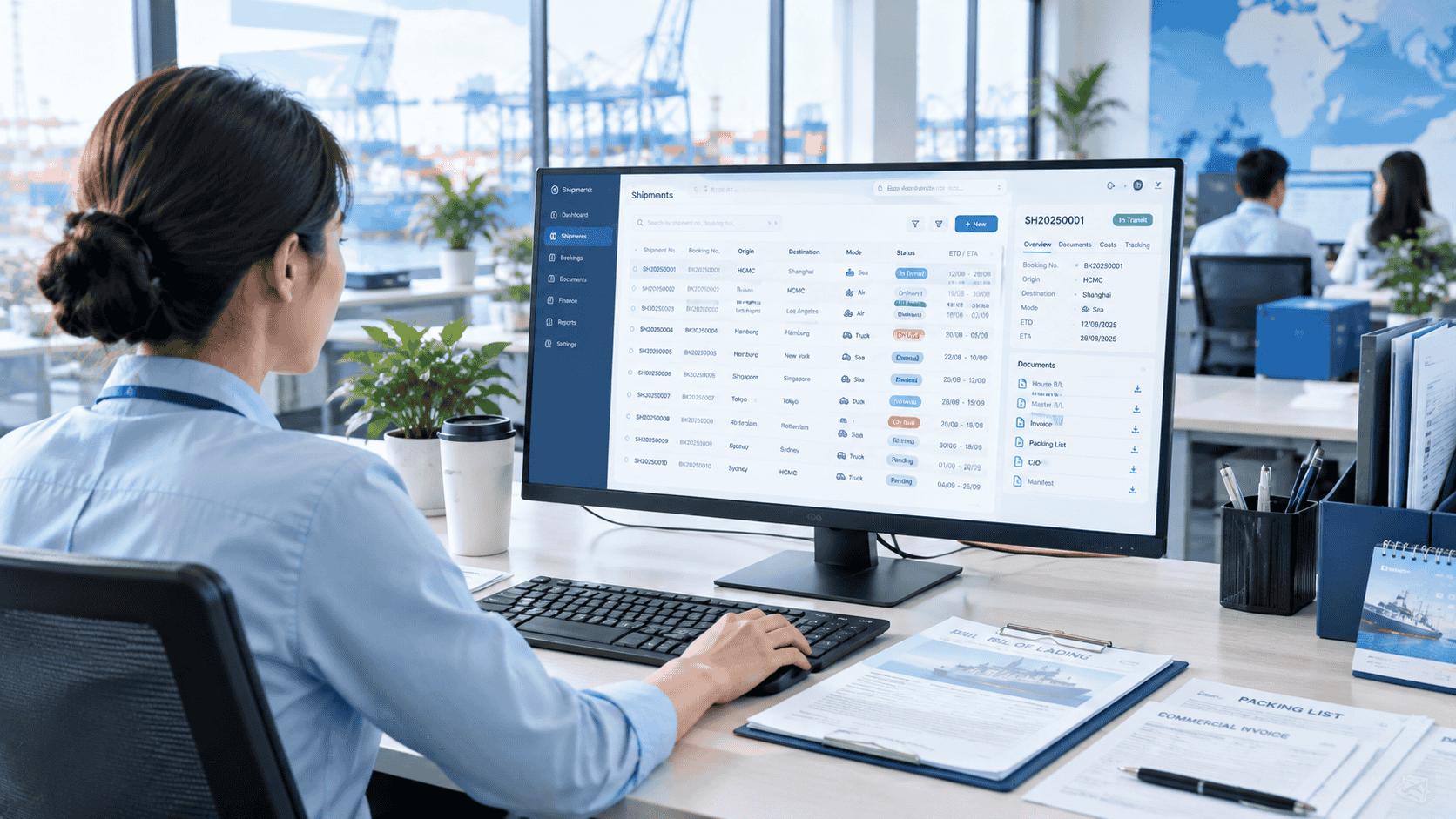
Every shipment generates a set of documents: house B/L, master B/L, invoice, packing list, C/O, manifest, arrival notice and delivery order. When data lives in Excel and email, retrieval is slow and inconsistencies between departments are hard to avoid.
An ERP uses the shipment (job) as its central unit: booking, documents, costs, revenue and transport status are all attached to a single record. Quotations convert into bookings without re-entering data, and documents link automatically to the job and house B/L.
Sota FMS follows this approach, covering Job, House B/L and Master B/L management, as well as customizable HBL print templates and E-Manifest. Its AI OCR feature reads bookings, extracts the data and populates job information, reducing manual entry. Customers can also track order status in real time on the website.
2. Controlling price lists, quotations and profit per shipment
This is the application with the most direct impact on profit margin. Freight forwarders work with many shipping lines, airlines and agents, each with different rates, routes and validity periods. If price lists are scattered across individual employees, comparing buying rates and preparing quotations becomes slow and inconsistent.
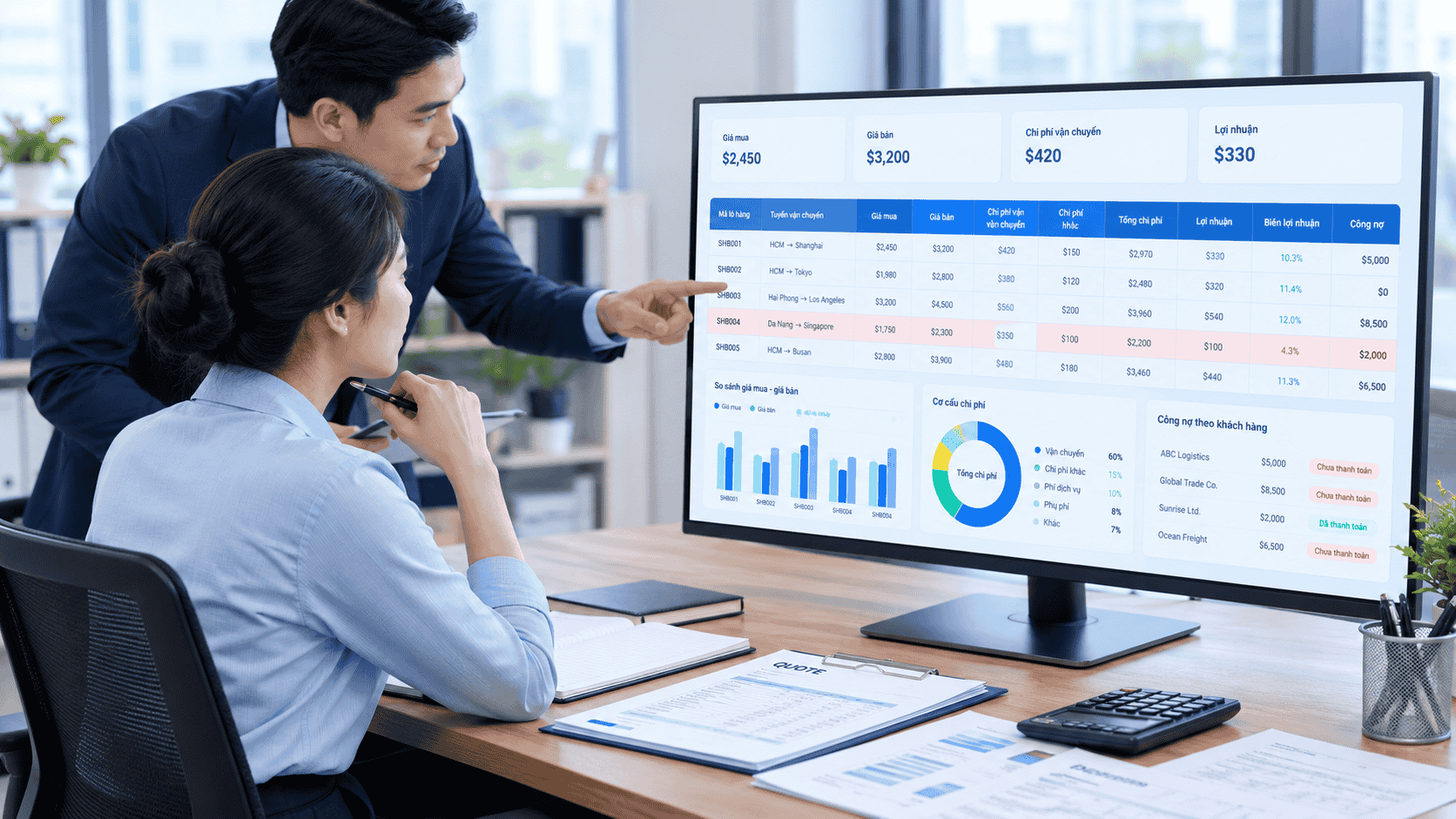
An ERP centralizes supplier price lists, allows buying and selling prices to be compared, and shows expected profit at the moment of quotation. Once a shipment is completed, the system calculates profit and loss per shipment, helping business owners identify which customers and routes are truly profitable.
Sota FMS manages three pricing layers (Buying, Buying Rate, Selling), clearly separating vendor cost, internal rates and customer selling prices. Sales staff can see only the rates assigned to them, not the actual cost price. The system automatically allocates costs from the Master Bill to House Bills by volume (sea freight) or chargeable weight (air freight), and calculates profit and loss per shipment, per sales representative, and the corresponding commission.
3. Accounting, receivables and payables, and cash flow management
Logistics companies often advance freight and fees to suppliers while customers pay late, so cash flow pressure is a common risk. When accounting is separated from operations, receivables and payables data is compiled manually and always lags behind reality.
An ERP links operational data with the ledger. Revenue and costs incurred on a shipment flow directly into receivables, payables, VAT and accounting entries. As a result, reconciliation time shortens, accuracy improves and outstanding balances can be tracked by customer and by shipment.
Sota FMS automatically generates multi-currency Debit Notes and Credit Notes linked to jobs and House/Master B/Ls, and integrates with accounting to issue invoices and post entries. The accounting module supports cash flow, banking, VAT, e-invoicing and payroll, with full audit logs.
4. Managing transport, warehousing and inventory in real time
For transport, warehousing and supply chain businesses, real-time data visibility is a prerequisite for planning. An ERP automates goods receipt and issue, stocktaking, invoicing and order tracking, while connecting information from purchasing and suppliers through to delivery. Accurate inventory helps avoid overordering and stockouts and keeps deliveries on schedule.
Road transport accounts for 74.7% of domestic freight volume according to the Vietnam Logistics Report 2025, and according to a representative of OCL Logistics, it makes up about 80–90% of total logistics costs. Tight coordination and tracking of this segment has a significant effect on overall cost.
Sota FMS focuses on freight forwarding operations and offers APIs for connecting with other platforms. For domestic transport management needs, the Sota Solutions ecosystem also includes Sota TMS.
5. Real-time reporting, CRM and decision support
Business owners need data to answer questions such as which routes are profitable, which customers pay late and which sales representatives are meeting their targets. When data sits in multiple systems, consolidation takes days and reliability is low.
An ERP brings sales, operations and finance data into a single source. The CRM module tracks sales opportunities, quotations and customer care activities, while the reporting system allows business performance to be monitored in real time.
Sota FMS includes a Kanban-style CRM, real-time KPI tracking, flexible sales team organization and instant reports. Its online platform also suits teams working remotely: FTF, a Sota customer, previously ran its operations on Excel with a remote workforce, and after implementing Sota FMS gained the ability to monitor business performance in real time through role-based access control.

Sota FMS: an ERP designed specifically for the logistics industry
Sota FMS is an ERP software designed specifically for logistics and freight forwarding companies, covering CRM, quotations, bookings, jobs, accounting, pricing management and debit/credit notes through to reporting. The solution is aimed at businesses that currently rely on Excel, fragmented systems or outdated desktop software.
According to the vendor, Sota FMS can raise the level of automation by up to 65% and cut up to 60% of wasted operating time. The system has been successfully deployed at both SMEs and large enterprises in Vietnam, with training and 24/7 support.
Conclusion
Three factors determine the business performance of a logistics company: prices, costs and cash flow, and all three depend on data quality. ERP in logistics provides that data consistently, from shipments, price lists and receivables and payables to inventory and reports. When selecting a solution, business owners should prioritize one that fits industry operations and an implementation partner with logistics experience.
Want to see Sota FMS running on your own company's data?Book a demo hoặcstart a free trial to receive advice on an implementation roadmap.