A shipment departs from the Hai Phong branch. The quotation is handled by the representative office in Shanghai. The documents sit in a spreadsheet kept by the documentation team in Ho Chi Minh City. At month-end, management needs to know whether the shipment was profitable, but it takes several days of reconciliation to get an answer. For logistics companies operating across multiple units, this is a common scenario, and the cause lies in how data is organized rather than in the capability of any individual branch.
The specifics of the multi-branch model in logistics
Legally, branches and representative offices are both dependent units and do not have legal entity status. They differ in scope of activity. A representative office only performs a representative function under authorization and is not permitted to conduct business that generates revenue directly. A branch may conduct business within the company’s registered industries and may choose either independent or dependent accounting. For a branch with dependent accounting, corporate income tax is declared at the head office, so the head office needs complete and timely data from every unit.
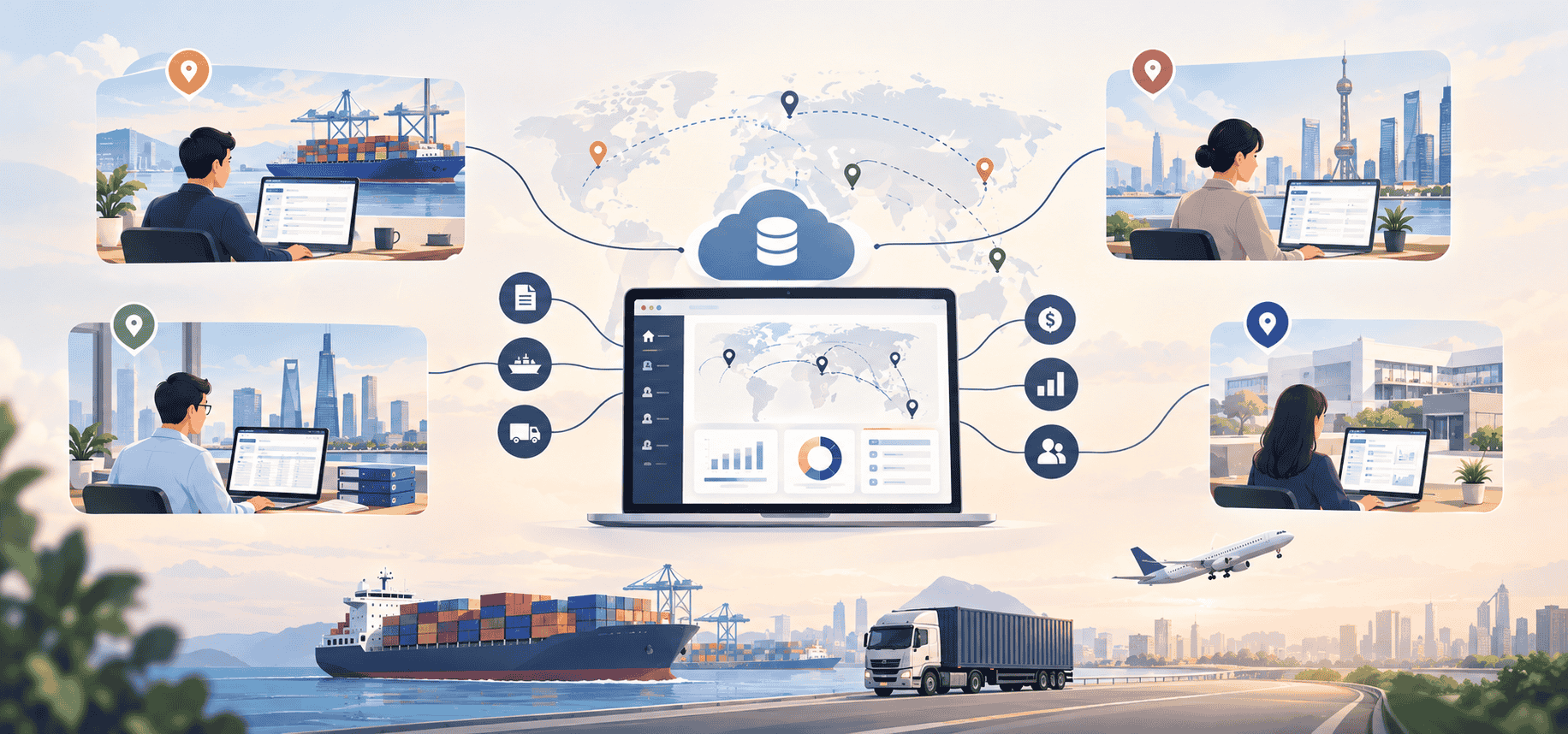
The logistics industry makes this problem more complex. A single shipment often involves a sales team in one location, an operations team in another, and agents or representative offices abroad. Data is generated at many points, while financial and legal responsibility rests with a single legal entity. This gap can only be narrowed when all units share one management system.
Five risks when each unit runs its own tools
1. No control over profit and loss by shipment. Revenue and costs are scattered across units. The company only learns the overall result after closing the books, without knowing which route, customer, or branch is eroding profit margins.
2. Weak control over buying and selling rates. Each unit keeps its own supplier rate sheets. When cost prices are widely shared, the company faces the risk of information leakage and internal price competition.
3. Fragmented documentation. House B/Ls, Master B/Ls, manifests, certificates of origin, and invoices are stored in multiple places. Slow retrieval increases the risk of errors and disputes with customers.
4. Slow and inconsistent consolidated reporting. Each branch uses a different data structure, the head office accounting team spends considerable effort on consolidation, and receivables are tracked with delays.
5. Dependence on individual experience. Processes are not standardized, so opening a new branch requires training from scratch, and service quality varies between units.
Five principles for Building a centralized management system
A single source of data. Customer and supplier lists, quotations, bookings, jobs, and receivables and payables are shared on one database. All units work from the same version of information.
Role-based and unit-based access control. Branch managers can view their own unit’s data, while the executive board can view the entire system. Representative offices access only what falls within their authorized scope. Sales staff see only the rates assigned to them, not cost prices.
End-to-end standardized processes. The workflow from sales opportunity, quotation, booking, and job through documentation and debit/credit notes to accounting entries should be identical across all units. This standardization makes the model replicable as the network expands.
Centralized control of pricing and margins. Buying rates, internal rates, and selling rates are separated into distinct layers. Master Bill costs should be allocated to each House Bill under a consistent rule.
Real-time reporting across multiple dimensions. Management needs to view results by branch, sales representative, customer, and trade lane, without waiting for manual consolidation at period-end.

How Sota FMS supports the multi-unit model
Sota FMS is an ERP system purpose-built for logistics and freight forwarding companies, integrating CRM, quotation, booking, jobs, House/Master B/L, and accounting on one platform. For companies with multiple branches and representative offices, the following capabilities offer direct value to managers:
- Centralized data with online access. Staff in different locations work on one system regardless of where they are. One Sota customer, whose team works entirely remotely, is still able to monitor sales and operational performance thanks to role-based access control.
- Three-layer pricing management (3PL). The system separates the supplier’s buying rate, the internal rate, and the selling rate to the customer. Sales staff see only the rates assigned to them, which keeps cost prices confidential between units.
- Automatic cost allocation. Costs from the Master Bill are distributed to House Bills by volume (sea freight) or chargeable weight (air freight).
- Profit and loss by shipment and by sales representative. The system calculates commissions automatically, providing a transparent basis for evaluating performance across units.
- Integrated accounting. Cash flow, banking, VAT, payroll, and e-invoicing are handled within the same system, with debit/credit notes automatically linked to each job.

Among Sota FMS customers in Vietnam, one example is a company whose parent entity in Thailand used a system that did not suit transport operations in Vietnam, forcing the local unit to rely on paperwork and Excel. After implementing Sota FMS, the company digitized its forwarding operations, CRM, accounting, and reporting in line with local regulations. This is a situation that many groups with branches in Vietnam are facing.
According to the vendor, Sota FMS can increase automation by up to 65% and reduce wasted operational time by up to 60%. Actual improvements depend on each company’s current state and scale.
An implementation roadmap for multi-branch companies
Step 1: Review the organizational model. List all units, their accounting approach (independent or dependent), the scope of activity of each branch and representative office, and the reporting flow to the head office.
Step 2: Standardize processes and master data. Agree on customer codes, supplier codes, charge structures, document templates, and cost allocation rules before digitizing.
Step 3: Design the access control model. Define who can view, edit, and approve which data, especially cost prices, profit, and receivables and payables.
Step 4: Pilot, then scale. Start with one branch, measure results, adjust processes, and then roll out to the remaining units.
Criteria for evaluating a solution
When selecting a system, business owners should check five points: specialized logistics functionality (House/Master B/L, e-manifest, debit/credit notes); role-based and unit-based access control; profit and loss reporting by shipment and by branch; accounting integration that complies with Vietnamese regulations; and the vendor’s capability in implementation, training, and support.
Conclusion
Effective management of multiple branches and representative offices starts with a shared data platform, unified processes, clear access control, and timely reporting. A logistics company with such a system gains control over profit margins, cash flow, and service quality as its network expands.
If your company is considering a centralized management solution, learn more abou Sota FMS or register for a consultation to receive an assessment tailored to your organizational structure.