The Vietnamese logistics industry is standing at a critical turning point. Logistics costs still account for a high percentage of GDP, profit margins are thinning, while customer expectations for speed and transparency continue to rise. In this context, digital transformation in logistics is no longer a trendy option, but a prerequisite for businesses to maintain their competitive edge.
However, up to 70% of businesses fail or fall short of expectations when implementing digital transformation due to the lack of a clear strategy. To help business owners avoid unnecessary pitfalls, here is a successful 5-step logistics digital transformation roadmap, drawn from the practical experience of leading experts.
Why is digital transformation imperative for logistics businesses?

Before diving into the roadmap, it is crucial to understand the driving forces behind it. Logistics companies operate on a complex network of transportation, warehousing, documentation, partners, and customers. When these processes still rely on paperwork, Excel spreadsheets, and manual communication, businesses face numerous bottlenecks:
- Lack of visibility: Inability to track cargo locations and order status in real time.
- Data errors: Manual data entry leads to discrepancies, making freight audit and billing reconciliation difficult.
- Hidden costs: Empty runs (deadhead miles), unoptimized routing, and excess inventory.
- Slow decision-making: Siloed data deprives leaders of instant reports needed for timely responses.
Digital transformation addresses these issues at their root by digitizing processes, connecting data, and automating tasks. As a result, businesses achieve greater operational transparency, lower costs, and better customer service. The remaining question is: what is the right sequence for implementation?
The detailed 5-step logistics digital transformation roadmap to success
To achieve a successful digital transformation, businesses must transition methodically from strategic thinking to technological execution:
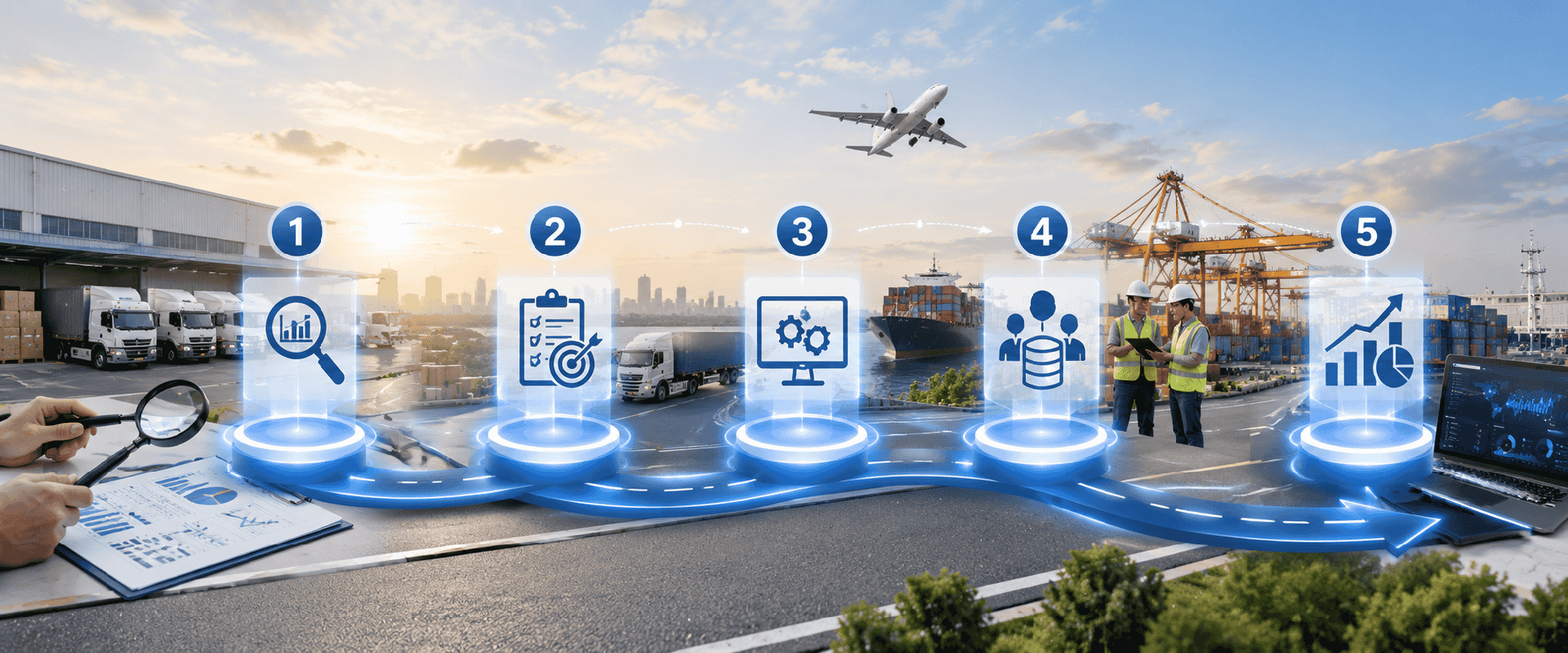
Step 1: Assess current status and define digitalization goals
Every successful digital transformation journey begins with an honest self-assessment. At this stage, business owners need to conduct a comprehensive "health check" across all operations:
- Map out current processes from order intake, transport dispatch, and warehouse management to invoice reconciliation.
- Identify bottlenecks that drain time and budget, or are prone to errors.
- Evaluate the organization's digital maturity: including tech infrastructure, workforce capabilities, and data culture.
Most importantly, businesses must align digital transformation with specific business objectives. Do you want to cut transportation costs by 15%? Halve order processing times? Boost your On-Time In-Full (OTIF) delivery rate? The clearer and more measurable the goals, the easier it will be to steer the roadmap and evaluate ROI later on.
Step 2: Define the strategy and prioritization roadmap
After gaining a clear understanding of the current status, a common mistake is attempting to "digitize everything at once." This approach often leads to resource overload, employee resistance, and mid-way project failure. Instead, build a focused strategy guided by clear prioritization principles.
A highly effective framework is the Impact-Effort Matrix: prioritize implementing items that deliver high value but require low effort. Typically, these involve core challenges such as transportation management, fleet dispatching, or order management.
At this stage, choosing a consulting partner who deeply understands industry specifics will help businesses avoid costly pitfalls. Sota Solutions is a dedicated digital transformation consulting and implementation partner specialized in the logistics sector. We accompany you right from the strategic planning phase to ensure your roadmap stays on track and aligns with your actual capabilities.
Step 3: Deploy the core technology platform
This step turns strategy into concrete action. A robust technology ecosystem for a logistics enterprise is typically built upon three core systems:
- Transportation Management System (TMS): Automates dispatching, optimizes routing, tracks shipments in real time, and manages freight costs.
- Enterprise Resource Planning (ERP): Unifies finance, warehousing, human resources, and operations onto a single data platform.
- Customer Relationship Management (CRM): Manages quotations, contracts, and customer care tailored to the unique characteristics of logistics services.
For these systems to maximize their value, they must be seamlessly integrated rather than operating in silos. When these three systems run on the same data pipeline, the business eliminates "information silos"—the biggest barrier to digitalization.
The implementation principle should be "start small, scale fast": select a single workflow or branch for a pilot project, validate its effectiveness, and then expand.
Step 4: Standardize data and train people
Technology only accounts for about half of the digital transformation story. The rest lies in data and people—the two decisive factors determining whether the system will actually be adopted and deliver value.
Regarding data, Businesses need to standardize customer directories, routing, tariffs, and commodity codes before migrating them into the system. Having "clean" data right from the start avoids the "garbage in, garbage out" syndrome, which can distort all subsequent reports.
Regarding people, This is often the most underestimated factor, yet it is the leading cause of project failure. Employees tend to resist change if they do not understand the benefits or feel threatened by it. Business owners need to:
- Communicate clearly about the purpose and benefits of digital transformation.
- Provide role-based training to ensure everyone becomes proficient in using the tools.
- Appoint "change champions" in each department to support their peers.
Only when people are onboard and data is reliable will the new system truly come alive in daily operations.
Step 5: Measure, optimize, and continuously scale
Digital transformation is not a project with a fixed end point, but a journey of continuous improvement. In this final step, businesses need to establish a measurement mechanism based on the Key Performance Indicators (KPIs) set in Step 1: On-Time In-Full (OTIF) rates, cost per order, empty run rates, inventory turnover, and more.
Thanks to centralized data visualized through dashboards, leaders can make data-driven decisions rather than relying on intuition. From there, businesses can constantly detect areas for optimization, test improvements, and scale digitalization to new workflows, such as predictive demand analytics or warehouse automation.
This is also when the value of technology investment compounds over time: the more data accumulated, the smarter the system becomes, and the more accurate the decisions.
Sota Solutions – Your trusted partner on the logistics digitalization journey

Understanding the barriers and challenges that logistics business owners encounter when self-implementing digital transformation, Sota Solutions was founded with the mission to provide comprehensive, prestigious, and market-leading digital transformation solutions.
Going far beyond the role of a traditional software vendor, Sota Solutions acts as a strategic consultant, accompanying your business to build a standardized roadmap right from the very first steps. The specialized technology ecosystem of Sota Solutions is engineered to thoroughly eliminate every pain point in the transport and freight forwarding industry:
- Sota TMS (Transportation Management System): A solution designed to optimize fleet management, automate delivery planning, enable real-time tracking, and strictly control fuel expenses across every trade lane.
- Sota FMS (Comprehensive ERP for Logistics Enterprises): The operational "brain" that seamlessly connects frontline activities with financial accounting, automates complex billing reconciliation (handling multi-currency, debit/credit notes), and empowers business owners to make data-driven decisions.
- Sota CRMlog (Specialized CRM for Logistics): A system tailor-made for logistics sales teams to manage intricate tariff setups and quotations by shipping lines or routes, while tracking customer lifecycles to drive breakthrough revenue growth.
Backed by a team of seasoned experts who deeply understand both local Vietnamese and international logistics workflows, Sota Solutions commits to delivering a smooth digital transformation roadmap that saves time and optimizes investment costs for your enterprise.
Conclusion
Digital transformation in the logistics industry is a methodical journey, not a game of chance. By navigating through these five steps—assessing the current status, defining the strategy, deploying core technology, standardizing data and people, and continuously measuring and optimizing—business owners can turn digitalization from a daunting challenge into a sustainable competitive advantage. Above all, choosing the right partner is the ultimate key to guaranteeing project success.
Do not let technological barriers hold back your progress. Contact Sota Solutions today to receive a free 1-1 consultation on the most suitable digital transformation roadmap for your business scale!