Every time a technology investment proposal is brought to the leadership table, the first question is never "what can this software do" — but rather "how long is the payback period, and what is the exact savings figure?"
With a transport management system (TMS), this question carries particular weight. Logistics costs typically account for 6-10% of revenue for manufacturing and distribution businesses in Vietnam. A small error in transport management — deadhead running, unoptimized routing, a lack of fuel cost control — silently erodes profit margins every day.
This article does not speak vaguely about the benefits of a TMS. Instead, we will go straight to the numbers: how much businesses actually save, under which specific cost categories, and how long it takes for a TMS investment to start turning a profit.
1. What is the true nature of ROI in a TMS implementation project?
Before diving into specific numbers, businesses need a proper understanding of ROI (return on investment) in a logistics technology project. For a TMS, ROI is not just the direct cash saved on each shipment. It is a composite indicator made up of two factors:
- Hard ROI (tangible benefits): Cost savings that can be directly measured in cash, such as reduced fuel costs, lower outsourced fleet expenses, decreased late delivery fines, and reduced employee overtime hours.
- Soft ROI (intangible benefits): Indirect but sustainable values, including increased customer satisfaction, standardized data for strategic decision-making, reduced operational pressure on staff, and enhanced brand reputation.
Typically, businesses adopting a smart transport management ecosystem can expect a payback period of 6 to 12 months once the system runs smoothly.
2. How much cost can businesses save? Quantitative analysis
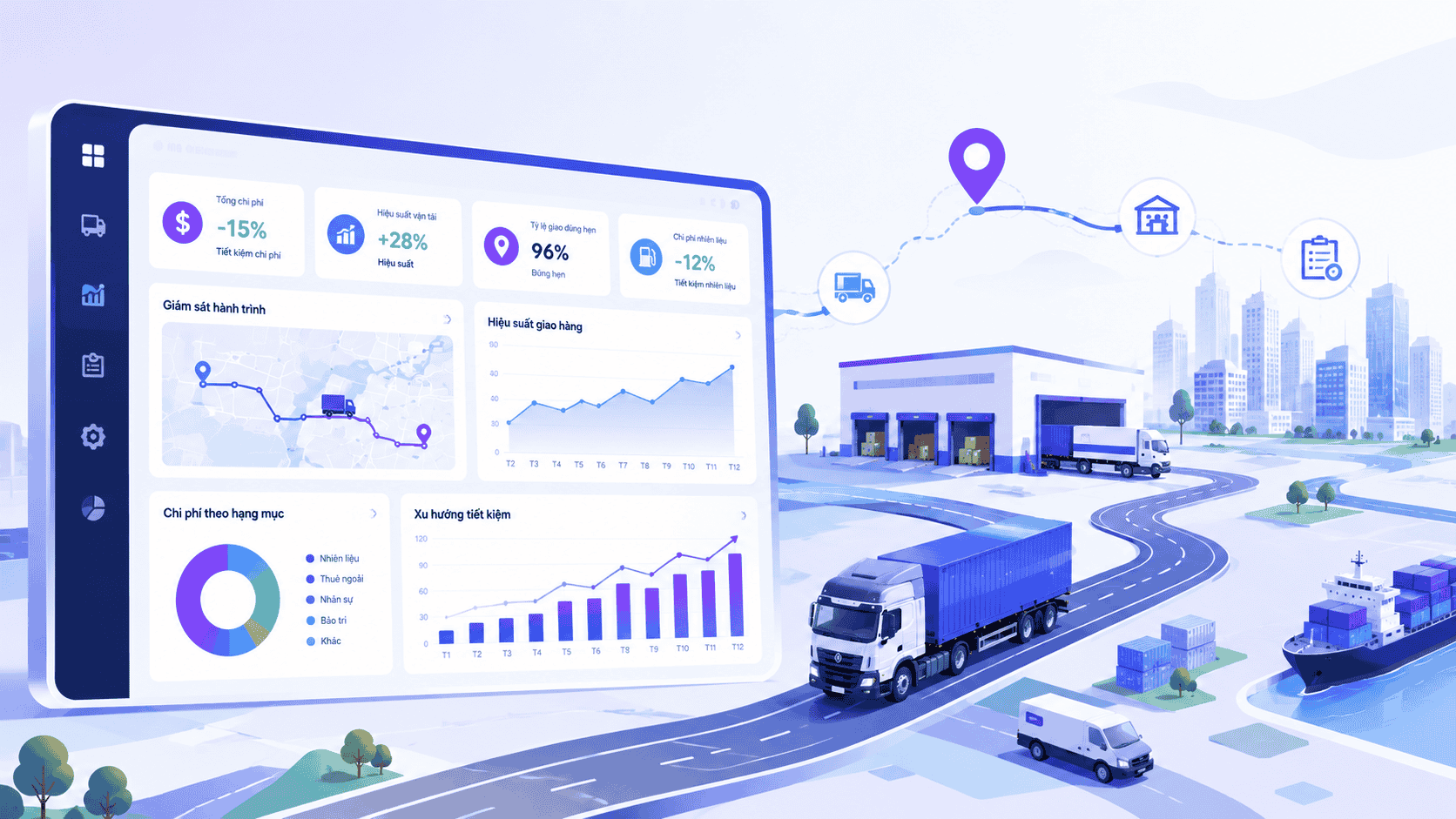
According to market research reports from Gartner and ARC Advisory Group, implementing a professional TMS ecosystem helps businesses save an average of 5% to 15% on total transport costs. Let's break down the specific cost categories:
2.1. Cut 10% - 15% of costs through route optimization
Manual planning using Excel often leads to subjective vehicle allocation, overlapping routes, empty backhauls, or unoptimized capacity.
- How TMS solves it: It uses smart algorithms to automatically calculate the shortest routes, avoid traffic bottlenecks, and optimize the delivery sequence for each vehicle.
- The savings figure: Reduces total travel distance by 10% to 15%. This means businesses directly cut fuel costs, vehicle wear and tear, and driver expenses for every kilometer driven.
2.2. Save 5% - 8% of costs through capacity management and smart procurement
For businesses that combine both an in-house fleet and third-party logistics (3PL), a lack of visibility into vehicle capacity and market freight rates results in significant waste.
- How TMS solves it: The system automatically suggests freight consolidation options to maximize vehicle capacity, avoiding the "large truck carrying a small load" scenario. At the same time, the freight bidding feature allows businesses to compare prices among carriers in an instant to select the most optimal rate.
- The savings figure: Reduces outsourcing costs by 5% to 8% thanks to increased transparency and maximizing the utility of the internal fleet.
2.3. Reduce 30% - 50% of operational time and administrative costs
Manual processes — from order approval, vehicle dispatching, and confirmation calls, to invoice reconciliation — consume a massive amount of time for dispatchers and accountants.
- How TMS solves it: It digitalizes the entire end-to-end process. Accounting, warehousing, sales, and dispatch departments work on a single, unified platform. Freight and surcharge reconciliation are automated, minimizing human error.
- The savings figure: Cuts up to 50% of administrative processing time. Staff can manage twice the volume of orders without increasing headcount.
2.4. Eliminate hidden costs from order cancellation penalties and late delivery compensations
A lack of real-time tracking leaves businesses reactive when transit disruptions occur (vehicle breakdowns, traffic jams, accidents), leading to late deliveries and fines from partners or supermarkets.
- How TMS solves it: It monitors vehicle locations continuously and triggers automatic alerts when there is a risk of delay, allowing dispatchers to handle issues promptly. Customers also receive estimated time of arrival (ETA) notifications, enhancing professionalism.
- The savings figure: Minimizes contract compensation risks and retains strategic customers — a value that cannot be measured simply by short-term cash.
3. Sample ROI calculation table: A business with a 100-truck fleet
To visualize this, let's look at a hypothetical scenario for a medium-sized transport or distribution business:
Cost item | Current cost / month | Savings rate | Savings amount / month |
Fuel | 2.4 billion VND | 12% | 288 million VND |
Dispatch staff | 150 million VND | 30% (reallocated) | 45 million VND |
Empty runs (backhauls) | 600 million VND | 25% | 150 million VND |
Cost leakage / reconciliation | 80 million VND | ||
Late delivery fines | 100 million VND | 60% | 60 million VND |
Total savings / month | 623 million VND | ||
Total savings / year | ~7.5 billion VND |
With TMS implementation costs ranging from 500 million to 1.5 billion VND (depending on scale and features), the payback period is only about 1 to 3 months for a business of this size. Even for smaller companies (20 to 30 trucks), the ROI remains positive within 6 to 9 months.

4. Beyond the numbers: The "intangible" ROI values
The ROI of a TMS does not just lie in direct cost savings. There are values that are difficult to measure in cash but have a long-term impact on competitiveness:
- Data-driven decision-making: Instead of relying on guesswork, leadership has real-time dashboards on fleet performance, route costs, and delivery KPIs. Every decision to expand routes, add vehicles, or change carriers is backed by data.
- Scalability: A business can double its order volume without needing to double its dispatch team. A TMS allows for scaling without a linear increase in operational costs.
- Customer experience: Real-time order tracking, automated notifications, and accurate ETAs are becoming the minimum standard, rather than just a competitive advantage. Businesses without a TMS are gradually falling behind.

5. Common mistakes that cause ROI to fall short of expectations
Not every TMS project is a success. Several factors can cause ROI to be lower than expected:
- Choosing a solution that does not fit the business scale: A system that is too complex for a small company, or too simple for a large enterprise — both lead to waste.
- Lack of commitment from leadership: A TMS changes workflows. Without top-down support, the team will revert to old habits.
- Failure to integrate with existing systems: A TMS works most effectively when connected to an ERP, WMS, or order management system. Implementing it in isolation will limit its value.
- Implementation partners lacking industry expertise: This is a frequently underestimated factor. A vendor with a deep understanding of transport operations — from driver management and capacity optimization to omnichannel delivery specifics — will significantly shorten the time to reach the target ROI. In Vietnam, Sota Solutions is one of the professional units in this field, featuring its Sota TMS product tailored specifically for the nuances of domestic transport.
6. Conclusion
Unlike many technology investments where the value is difficult to quantify, a TMS delivers clear, measurable ROI right from the very first months. With savings of 8-15% on total transport costs and a payback period of 6-12 months, this is no longer a question of "should we invest?" — but rather "how can we implement it most effectively?"
The key lies in choosing the right solution and the right partner. A smart TMS system designed for the Vietnamese market, combined with an implementation team that deeply understands transport operations — that is the formula to ensure ROI is not just on paper, but reflected in daily operational reality.
Please contact the expert team at Sota Solutions today to have your actual operational challenges surveyed and to build the most accurate ROI projection model for your business.